The answer to all life’s problems, questions, and curiosities — at least for me — are books.
Books are both a complement and an antidote to my inner life. I look for things in them. Guidance. Wisdom. Comfort. Company. For as long as I can remember, I have been extremely attached to books and have trouble being far away from them.
Travelling? I pack more than I could possibly read. At home, I have “house purses,” which have gotten progressively larger over time, allowing me to Sherpa many more books throughout the house at all times.
Books are one of the great technologies of human civilization: how else would the human mind survive its own lifetime? The simplicity of bounded ink on paper has carried our experiences, doubts, imagination, and wisdom across centuries, allowing us to encounter minds we could never otherwise have known.
I plan to live forever so that I can read. Classics, histories, translations, philosophy — and countless others I haven’t even discovered.
So when I got off the call with my psychiatrist, I only knew one action. The solution to my existential crisis was clear: I would find the essential writings on yoga, pranayama, and the Yoga Sutras.
Somewhere in those pages, I was certain, was a portal to an ancient wisdom — and perhaps, within it, a key to unlocking the Self.
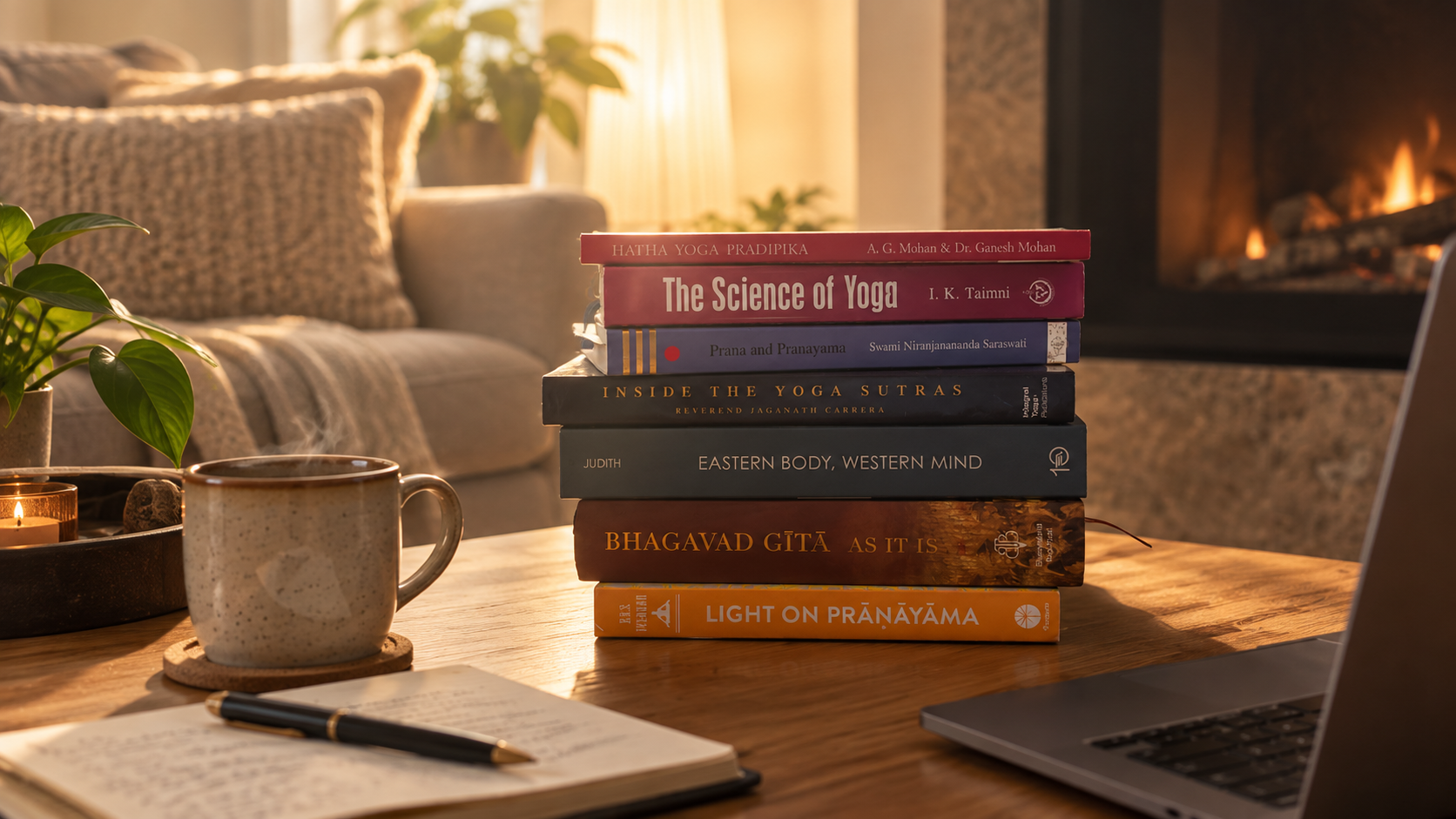
The stack began with:
Inside the Yoga Sutras, by Reverend Jaganath Carrera
Prana and Pranayama, by Swami Niranjanananda Saraswati
The Science of Yoga, by I. K. Taimni
Hatha Yoga Pradipika, by A. G. Mohan and Dr. Ganesh Mohan
Light on Pranayama, by B. K. S. Iyengar
Plus two additional books I pulled from my existing collection:
Bhagavad-gita As It Is, by A. C. Bhaktivedanta Swami Prabhupada
Eastern Body, Western Mind, by Anodea Judith
I didn’t know exactly what I was looking for. I only knew that somewhere inside these traditions were ideas about the mind, consciousness, suffering, attention, and the Self that felt urgent to me.
So I started reading.
I underlined. I dogeared. I stuck Post-Its throughout. I looked up Sanskrit words I could barely pronounce, and attempted to pronounce them. One book led to another, one idea opened into five more, and slowly the questions that had followed me out of my professional life began to widen into much older ones: What is the mind? What is the Self? What causes us to suffer? And beneath all the noise of modern life, what is actually there?
I had gone looking for a way through my own existential crisis.
Instead, I found a practice of inquiry that had been waiting for thousands of years. Like a genie with all the answers, and I was only just learning how to ask the right questions.
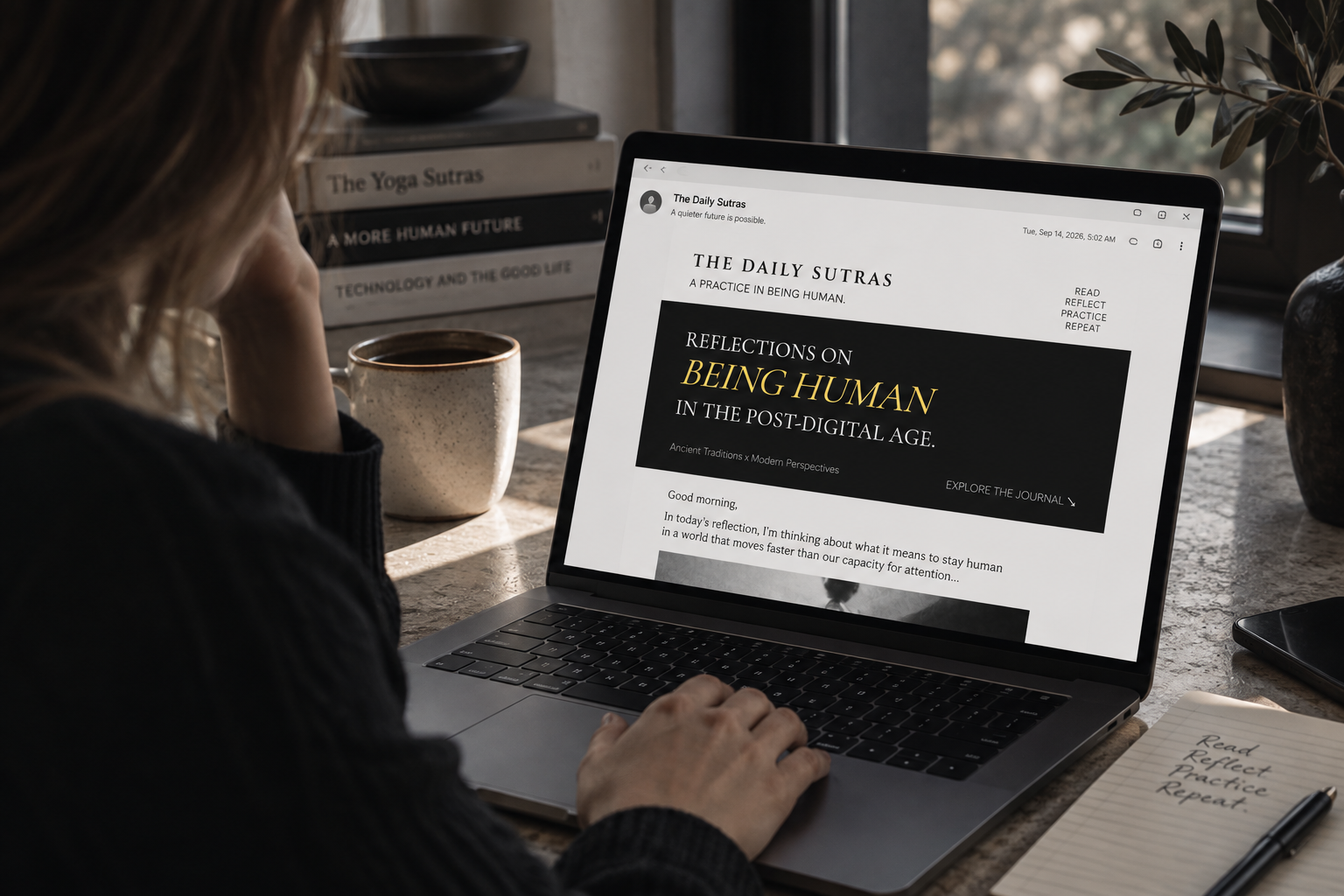
And somewhere along the way, that inquiry became The Daily Sutras.
When I didn’t know what to do next, I went where I have always gone for answers, comfort, and a way through.

The answer to all life’s problems, questions, and curiosities — at least for me — are books.
Books are both a complement and an antidote to my inner life. I look for things in them. Guidance. Wisdom. Comfort. Company. For as long as I can remember, I have been extremely attached to books and have trouble being far away from them.
Travelling? I pack more than I could possibly read. At home, I have “house purses,” which have gotten progressively larger over time, allowing me to Sherpa many more books throughout the house at all times.
Books are one of the great technologies of human civilization: how else would the human mind survive its own lifetime? The simplicity of bounded ink on paper has carried our experiences, doubts, imagination, and wisdom across centuries, allowing us to encounter minds we could never otherwise have known.
I plan to live forever so that I can read. Classics, histories, translations, philosophy — and countless others I haven’t even discovered.
So when I got off the call with my psychiatrist, I only knew one action. The solution to my existential crisis was clear: I would find the essential writings on yoga, pranayama, and the Yoga Sutras.
Somewhere in those pages, I was certain, was a portal to an ancient wisdom — and perhaps, within it, a key to unlocking the Self.
The stack began with:
Inside the Yoga Sutras, by Reverend Jaganath Carrera
Prana and Pranayama, by Swami Niranjanananda Saraswati
The Science of Yoga, by I. K. Taimni
Hatha Yoga Pradipika, by A. G. Mohan and Dr. Ganesh Mohan
Light on Pranayama, by B. K. S. Iyengar
Plus two additional books I pulled from my existing collection:
Bhagavad-gita As It Is, by A. C. Bhaktivedanta Swami Prabhupada
Eastern Body, Western Mind, by Anodea Judith
I didn’t know exactly what I was looking for. I only knew that somewhere inside these traditions were ideas about the mind, consciousness, suffering, attention, and the Self that felt urgent to me.
So I started reading.
I underlined. I dogeared. I stuck Post-Its throughout. I looked up Sanskrit words I could barely pronounce, and attempted to pronounce them. One book led to another, one idea opened into five more, and slowly the questions that had followed me out of my professional life began to widen into much older ones: What is the mind? What is the Self? What causes us to suffer? And beneath all the noise of modern life, what is actually there?
I had gone looking for a way through my own existential crisis.
Instead, I found a practice of inquiry that had been waiting for thousands of years. Like a genie with all the answers, and I was only just learning how to ask the right questions.
And somewhere along the way, that inquiry became The Daily Sutras.